Back to Active Exams
Bahria University
Active

Doctor of Philosophy in Computer Science (PhD CS) Admission - Bahria University

PhD Computer Science

Questions
50
Duration
1h
Passing Score
50%
Negative Marking
Category
Bahria University
Case No.

Before you start

Clicking "Start Preparing" will take you to the exam simulator. You will need to sign in or create a free account to launch the attempt. Preparation is completely free.
Exam Questions

O(1)
O(log n)
O(n)
O(n log n)
ExplanationIn a Fibonacci heap, the delete-min operation involves consolidating the root list, which takes amortized O(log n) time.
Dijkstra's Algorithm
Bellman-Ford Algorithm
Prim's Algorithm
Kruskal's Algorithm
ExplanationDijkstra fails with negative edges, while Bellman-Ford can handle them correctly by relaxing edges V-1 times.
m/2
ceil(m/2)
floor(m/2)
m-1
ExplanationTo maintain the balance of a B-tree, non-root internal nodes must be at least half full, defined as ceil(m/2) children.
Binary Max-Heap
Pairing Heap
Van Emde Boas Tree
Sorted Linked List
ExplanationVan Emde Boas trees provide O(log log U) time complexity for priority queue operations, where U is the universe size, outperforming standard heaps for certain integer ranges.
O(n log n)
O(n)
O(n^2)
O(log n)
ExplanationWhen the pivot is consistently extreme, the partition becomes highly unbalanced, resulting in a depth of n, leading to O(n^2) complexity.
Dijkstra's Algorithm
Kruskal's Algorithm
Bellman-Ford Algorithm
Floyd-Warshall Algorithm
ExplanationKruskal's algorithm sorts all edges by weight and adds them sequentially if they do not form a cycle, which is a greedy strategy for MST.
Guaranteed O(1) search time
Lower space complexity
Easier implementation for concurrent operations
Smaller constant factors
ExplanationSkip lists are highly preferred in concurrent programming because they allow localized updates, avoiding the global rebalancing locks required by trees like AVL or Red-Black trees.
Greedy Algorithm
Dynamic Programming
Backtracking
Divide and Conquer
ExplanationDynamic programming is used to solve the Knapsack problem by breaking it down into overlapping subproblems and storing results to build the optimal solution.
The recurrence must be in the form T(n) = aT(n/b) + f(n)
The subproblems must be solved sequentially
The function f(n) must be logarithmic
The problem must be non-recursive
ExplanationThe Master Theorem provides a cookbook solution for recurrences of the specific form T(n) = aT(n/b) + f(n).
log2(n+1)
2 log2(n+1)
n
log2(n)
ExplanationDue to the balancing properties (red nodes cannot have red children, paths have equal black nodes), the height is guaranteed to be at most 2 log2(n+1).
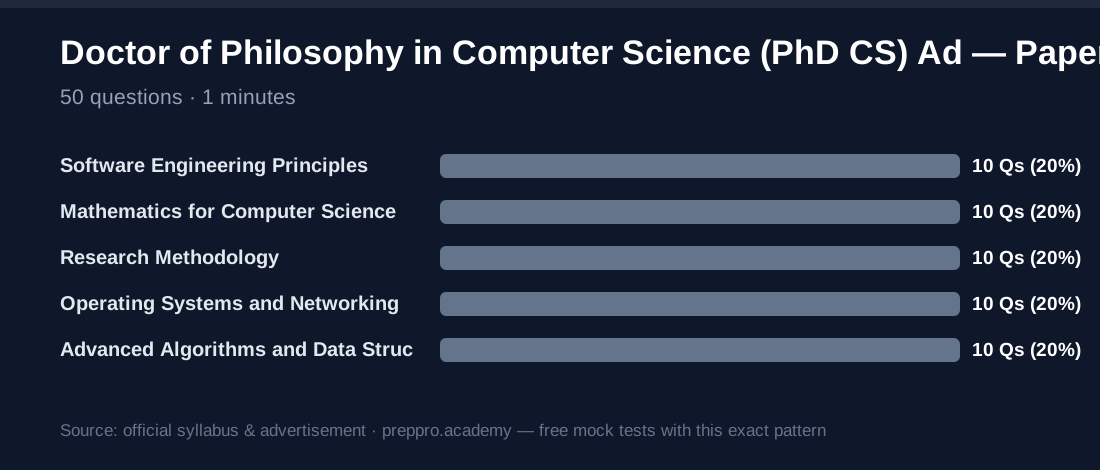
Doctor of Philosophy in Computer Science (PhD CS) Admission - Bahria University paper pattern infographic: subject-wise question distribution across 50 MCQs, 1h duration
Doctor of Philosophy in Computer Science (PhD CS) Admission - Bahria University — subject-wise question distribution, per the official syllabus

Student Reviews

No reviews yet — take this exam and be the first to review it!

Doctor of Philosophy in Computer Science (PhD CS) Admission - Bahria University — Frequently Asked Questions

How many questions are in the Doctor of Philosophy in Computer Science (PhD CS) Admission - Bahria University practice test?

This practice test currently has 50 MCQs, and every question includes the correct answer with an explanation.

How long is the Doctor of Philosophy in Computer Science (PhD CS) Admission - Bahria University mock test?

The full mock runs for 1h under real exam timing, just like the actual paper.

Is there negative marking in this test?

No negative marking is applied in this practice test. The rule for the real exam is announced in the official advertisement.

What score do I need to pass?

The passing score in this simulation is 50%, but for competitive merit you should aim well above it.

Is Doctor of Philosophy in Computer Science (PhD CS) Admission - Bahria University preparation free on PrepPro?

Yes — the questions, explanations and full timed mock test are all free. You can start practising right from this page.

How do I prepare for Doctor of Philosophy in Computer Science (PhD CS) Admission - Bahria University online?

Practise the syllabus-based MCQs, then sit the full timed mock test and use your result analytics to find and repeat weak topics — all of it starts free from this page.

Can I retake the Doctor of Philosophy in Computer Science (PhD CS) Admission - Bahria University mock test?

Yes — you can retake the mock test as many times as you like; every attempt is saved separately in your history so you can track your improvement.

Is the Doctor of Philosophy in Computer Science (PhD CS) Admission - Bahria University mock test available in Urdu?

Yes — this entire page has an Urdu mirror under /ur, and the preparation content is available in both English and Urdu.

More Bahria University exams

Continue your preparation

We use cookies

We use essential cookies to keep the platform running and analytics cookies to understand usage. You can accept or reject analytics and advertising cookies.