Zurück zu den aktiven Prüfungen

Bevor du beginnst

„Vorbereitung starten" führt dich zum Prüfungssimulator. Für den Start benötigst du ein kostenloses Konto. Die Vorbereitung ist komplett kostenlos.
Exam Questions

Salmonella
Clostridium botulinum
E. coli
Norovirus
ExplanationC. botulinum thrives in anaerobic, low-acid environments and produces a deadly toxin.
Poaching
Deep-frying
Braising
Sautéing
ExplanationDeep-frying is a dry-heat cooking method that uses fat to conduct heat, resulting in rapid moisture evaporation on the surface for a crispy texture.
To fully cook the vegetable through
To remove bitterness from all raw vegetables
To set the color and stop enzyme action
To caramelize the natural sugars
ExplanationBlanching involves briefly boiling food then plunging it into ice water, which sets the chlorophyll in green vegetables and halts the ripening process.
Poaching
Steaming
Braising
Sautéing
ExplanationPoaching is a gentle moist-heat cooking method where food is submerged in liquid at temperatures typically between 160°F and 180°F.
Sweating uses higher heat to brown the exterior.
Sweating cooks vegetables in fat over low heat without browning.
Sautéing requires a closed lid to retain moisture.
Sautéing uses only water-based liquids.
ExplanationSweating is meant to soften vegetables and release their aromatic flavors without triggering the Maillard reaction (browning).
Adding the butter at boiling temperature.
Whisking the eggs continuously over indirect low heat.
Using cold butter exclusively.
Boiling the sauce for 5 minutes after emulsification.
ExplanationHollandaise is an emulsion of egg yolks and butter; if the heat is too high or direct, the eggs will scramble, breaking the emulsion.
Julienne
Brunoise
Macedoine
Chiffonade
ExplanationBrunoise is the technical term for the smallest uniform cube cut, typically derived from a julienne cut.
To allow the surface proteins to oxidize
To prevent the exterior from becoming soggy
To allow juices to redistribute throughout the muscle fibers
To lower the temperature for safer carving
ExplanationResting allows the muscle fibers to relax and reabsorb juices that were pushed to the center during high-heat cooking.
Poaching
Braising
Steaming
Grilling
ExplanationBraising is a combination cooking method that uses both dry heat (searing) and moist heat (liquid) to break down tough fibers.
To cool the pan down before cleaning
To create a base for a sauce by loosening caramelized food particles
To increase the smoke point of the fat
To remove excess bitterness from the meat
ExplanationDeglazing uses liquid to lift 'fond' (browned bits) off the bottom of the pan to incorporate flavor into a sauce.
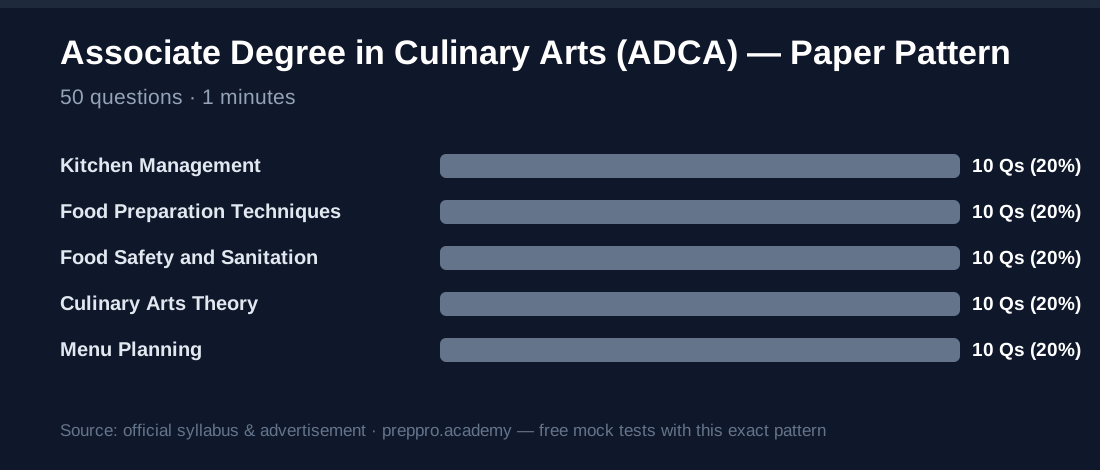
Associate Degree in Culinary Arts (ADCA) paper pattern infographic: subject-wise question distribution across 50 MCQs, 1h duration
Associate Degree in Culinary Arts (ADCA) — subject-wise question distribution, per the official syllabus

Bewertungen von Studierenden

Noch keine Bewertungen — lege diese Prüfung ab und bewerte sie als Erster!

Associate Degree in Culinary Arts (ADCA) — Frequently Asked Questions

How many questions are in the Associate Degree in Culinary Arts (ADCA) practice test?

This practice test currently has 50 MCQs, and every question includes the correct answer with an explanation.

How long is the Associate Degree in Culinary Arts (ADCA) mock test?

The full mock runs for 1h under real exam timing, just like the actual paper.

Is there negative marking in this test?

No negative marking is applied in this practice test. The rule for the real exam is announced in the official advertisement.

What score do I need to pass?

The passing score in this simulation is 50%, but for competitive merit you should aim well above it.

Is Associate Degree in Culinary Arts (ADCA) preparation free on PrepPro?

Yes — the questions, explanations and full timed mock test are all free. You can start practising right from this page.

How do I prepare for Associate Degree in Culinary Arts (ADCA) online?

Practise the syllabus-based MCQs, then sit the full timed mock test and use your result analytics to find and repeat weak topics — all of it starts free from this page.

Can I retake the Associate Degree in Culinary Arts (ADCA) mock test?

Yes — you can retake the mock test as many times as you like; every attempt is saved separately in your history so you can track your improvement.

Is the Associate Degree in Culinary Arts (ADCA) mock test available in Urdu?

Yes — this entire page has an Urdu mirror under /ur, and the preparation content is available in both English and Urdu.

More Riphah International University exams

Continue your preparation

Wir verwenden Cookies

Wir nutzen essentielle Cookies für den Betrieb der Plattform und Analyse-Cookies zum Verständnis der Nutzung. Analyse- und Werbe-Cookies kannst du annehmen oder ablehnen.